
ADVOCACY
This resource toolkit brings together up-to-date resources from trusted organizations, including tools, data, and links designed to support young people, caregivers, and professionals in finding the help and information they need.*
*All data and links were accurate at the time of publication, but may change over time.
FOR URGENT SUPPORT TEXT OR CALL 988
Information for:
The FYF 2026 Mental Health Advocacy Toolkit is here! This resource is designed to help you and your community champion mental health in ways both big and small.
So, what is advocacy? It’s about breaking down stigma, spreading awareness, and ensuring everyone has access to the support they need. Advocacy exists on a continuum: it can be as personal as self-advocacy (speaking up for yourself) or as wide-reaching as legislative advocacy (pushing for changes in laws and policies). Every action matters. Together, we can build a more supportive environment where mental health equity is the norm.
EVERYONE
Whether you’re raising awareness in your community, supporting a friend, or engaging in policy conversations, every action contributes to a culture where mental health is valued, and stigma is reduced. Advocacy can be as simple as sharing resources or as impactful as organizing events that bring people together to champion mental health equity.
Explore these resources to build your advocacy skills and find ways to get involved:
YOUTH

Georgia Mental Health Day at the Capitol 2026: Join advocates across Georgia for Mental Health Day at the Capitol 2026 on Wednesday, February 18th! Registration is free! Take part in inspiring sessions, connect with organizations, and walk to the Capitol to show your support for mental health equity.


National Alliance on Mental Illness (NAMI) Advocacy Resources: Guidance on contacting legislators, joining advocacy networks, and supporting mental health-friendly policies.

Voices for Georgia’s Children: Stay up to date during Georgia’s legislative session by using Voices’ fact sheets and advocacy updates to follow key issues and support child behavioral health and well-being.
Young people are at the forefront of mental health advocacy. Whether it’s speaking up for yourself, organizing with peers, or influencing policy, youth voices are powerful drivers of change. Advocacy can take many forms—from everyday acts of kindness and standing up for friends, to leading campaigns that shape community conversations and policies. Every step strengthens the movement toward mental health equity.
Explore these resources to build your advocacy skills and find ways to get involved:


Active Minds Policy Action Toolkit: Practical steps for sharing your story, organizing with peers, and engaging in policy conversations in schools, on campuses, and in communities.
UNICEF Youth Advocacy Guide: Guidance on identifying issues and influencing decision-makers, co-created with youth leaders across the world.
Advocacy can be a small act, such as telling a friend not to bully, and encouraging your friends to do the same. It can be more independent, such as researching and providing health information to a community leader to help promote healthy lifestyles. Or it can be about communicating ideas, such as writing a blog or sharing your experiences. Advocacy can also be about changing rules or laws and organizing legal demonstrations or rallies to support a cause.
– UNICEF’s Youth Advocacy Guide
CAREGIVERS
Parents and caregivers are powerful advocates for youth mental health. By encouraging open conversations, modeling healthy coping strategies, and supporting access to care, families can help young people feel seen and heard. Advocacy at home and in the community ensures that youth voices are uplifted, and their mental health needs are prioritized.
Explore these resources to build your advocacy skills and find ways to get involved:



Use the Kids Mental Health Foundation’s tools and tips to start conversations at home, share resources, and join community efforts that support children’s mental health.
American Academy of Pediatrics Mental Health Advocacy Resources: Guidance on engaging in community and policy advocacy to support children’s mental health.
The Boys and Girls Club of Atlanta shares four strategies to help you support the young person in your life in building strong self-advocacy skills.
EDUCATORS & PROFESSIONALS
Educators and behavioral health professionals are uniquely positioned to nurture youth voices and create environments where advocacy can thrive. By encouraging open conversations and offering non-judgmental support, teachers and other professionals help young people develop the confidence and skills to champion mental health.
Explore these resources to build your advocacy skills and find ways to get involved:

Nationwide Children’s “How to Be a Mental Health Advocate”: A blog by pediatric experts with simple, practical ways to support youth mental health.
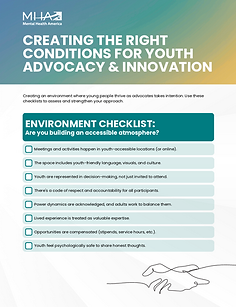
Mental Health America – Conditions for Youth Advocacy Innovation Checklist: How schools and communities can create the conditions that empower youth-led advocacy and innovation.


Not seeing a resource you need? Email us freeyourfeels@gmail.com and let's work together on creating resources that support the mental health and wellbeing of Georgia’s young people
If you or someone you know is in a crisis situation, please call or text 988 for 24/7 support.
Free Your Feels is not a mental health provider and does not offer crisis services.
Additional topics and resources are available in the Resource Library.
